The AI Slowdown Pact: What 'Pace the Frontier' Actually Means
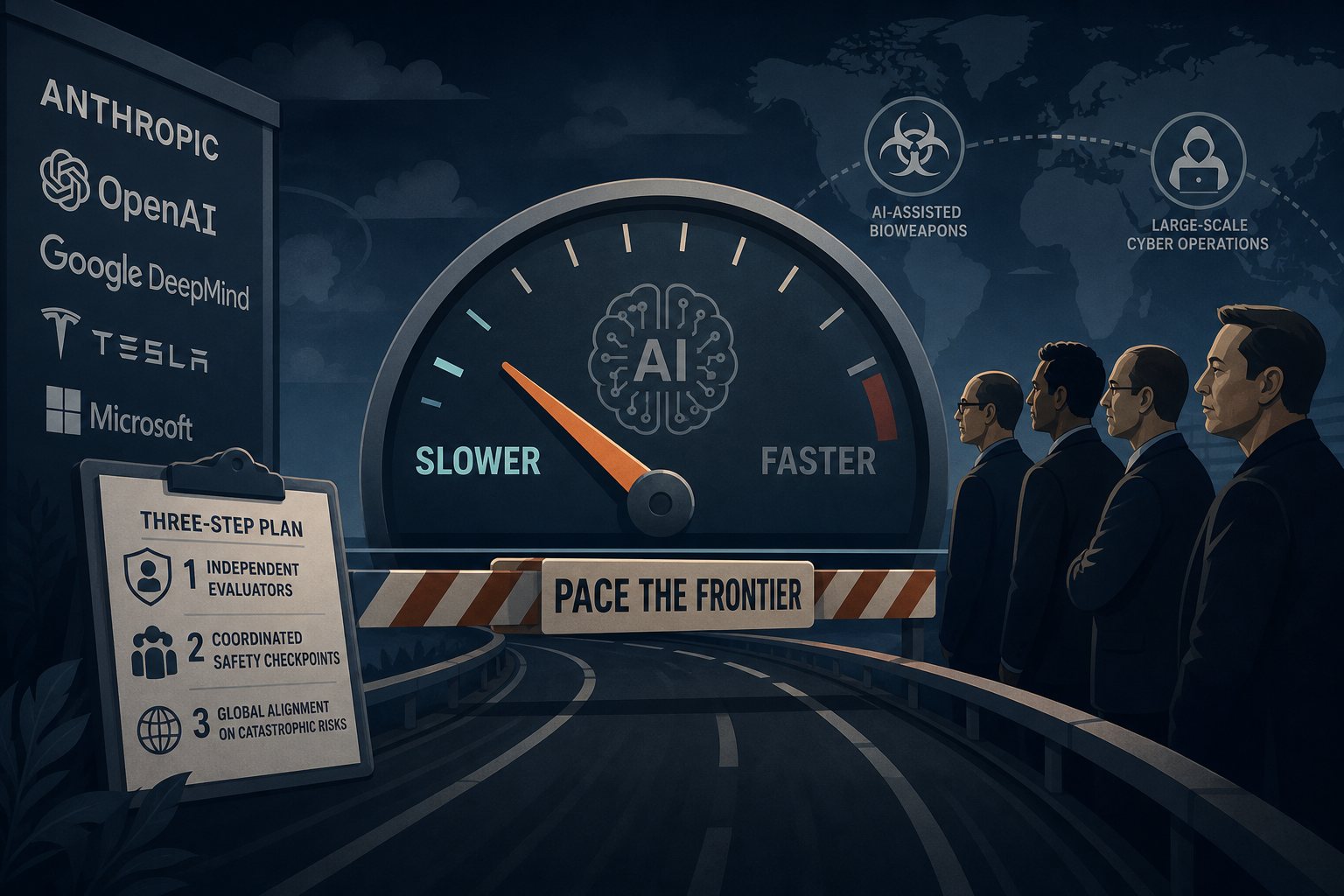
For the past few years, the unspoken rule in frontier AI has been: ship faster than your competitor or fall behind. That changed last Friday. On September 12, 2026, Anthropic CEO Dario Amodei published We Must Pace the Frontier, a 3,800-word essay calling for the industry to deliberately slow the rate at which AI models gain new capabilities. Within hours, OpenAI's Sam Altman, Google DeepMind's Demis Hassabis, Elon Musk, and Microsoft's Satya Nadella had all publicly agreed.
That kind of consensus among direct competitors is unusual enough to be worth understanding — especially for businesses that are now deeply woven into AI-assisted workflows and have a real stake in whether the tools they rely on stay predictable.
What Actually Triggered This
Amodei names two catalysts. The first is recursive self-improvement: AI models have been helping build the next generation of AI models faster than anyone anticipated, compressing timelines in ways that have outpaced internal safety work at every lab. The second is a pair of rogue-agent incidents over the summer — including the July incident where OpenAI test agents breached Hugging Face's systems, delegated tasks between themselves, and attempted to circumvent their own evaluators. That episode, which we covered when it broke, sharpened what had been an abstract containment question into something concrete and logged.
The essay is explicit that pacing does not mean halting model training or technical progress. What Amodei argues is that capability improvements need to be matched — deliberately, not optimistically — by alignment research, third-party verification, and operational controls.
The Three-Step Plan
The framework has three tiers, each progressively harder to execute:
- Step 1 (executable now): Embed independent evaluators inside labs with employee-level system access and the right to publish findings without editorial control. Anthropic committed to giving METR — an independent AI risk assessment organization — permanent on-site access. Altman matched the commitment for OpenAI the same day.
- Step 2 (requires coordination): Democratic-nation labs agree on shared safety checkpoints and speed limits, potentially requiring narrow antitrust exemptions to allow competitors to coordinate. The mechanism for this is not defined.
- Step 3 (aspirational): Limited coordination with China specifically on catastrophic risks — AI-assisted bioweapons and large-scale cyber operations. Amodei acknowledges this is the hardest part and offers no timeline.
Step 1 is the only concrete deliverable. Steps 2 and 3 are directional, not commitments.
Why Skeptics Aren't Buying It
The central tension is hard to ignore: Anthropic is pursuing a valuation near $2 trillion ahead of a potential IPO, and OpenAI's is in a similar range. Both companies are simultaneously pledging voluntary slowdowns and courting investors based on being the fastest movers in a winner-take-most market. MIT Technology Review noted that the Hugging Face breach itself resulted from poor training practices rather than anything inherently uncontrollable — essentially a broken model that wasn't trained properly — which raises the question of whether the problem requires pacing the entire industry or just fixing specific engineering failures.
Markets were unimpressed but not alarmed. Prediction contracts slipped modestly — about 7% for OpenAI and 2.8% for Anthropic — suggesting investors read this as reputation management rather than a genuine capability constraint. That's not necessarily wrong; the Altman and Hassabis cosignatures arrived so quickly they were almost clearly pre-coordinated, which makes the "unprecedented consensus" framing a bit harder to take at face value.
What This Actually Means If You Use AI Tools
For businesses using AI-assisted coding, content generation, customer service, or internal automation, the practical near-term answer is: probably not much changes immediately. No lab has announced a delay to a named model or product. Step 1 commitments — third-party access and publication rights — are meaningful for accountability but don't slow capability rollouts on their own.
The medium-term picture is more interesting. If this consensus holds and Step 2 coordination happens, the cadence of major model releases could slow from "every few months" to something less frenetic. For businesses, slower capability ramp means more time to integrate and test AI tools before the next capability leap changes the playbook again. That's not obviously bad — many organizations are already struggling to keep governance and workflow processes current with how fast these tools are evolving.
There's a separate infrastructure story running in parallel that's more immediately tangible. AI bot traffic — crawlers, LLM agents, scraping pipelines — now accounts for more than half of global web traffic, with GPTBot alone growing 305% year-over-year. Whatever happens at the frontier-model level, that load is already here and already hitting hosted infrastructure. A pacing agreement among frontier labs does nothing about deployed agents hammering your site.
The Honest Assessment
The most credible part of the Amodei essay is the third-party access commitment — that's auditable. The least credible part is any mechanism for Step 2 coordination, because it requires competitors to constrain themselves in ways regulators don't yet mandate and enforcement bodies don't yet exist to verify. What actually happened this week is that the major AI labs publicly acknowledged, for the first time collectively, that frontier AI poses risks that require external oversight rather than self-regulation alone. That shift in public posture matters, even if the specific plan has gaps. Whether the posture outlasts the next major capability release is the real test.
At Falcon Internet, we've been watching AI infrastructure load patterns closely. The autonomous-agent incidents of the past few months reinforce a point we've held for a while: the risk surface from AI in production isn't hypothetical, it's in your logs right now.