Public Exploit Drops for GitLab RCE Buried in a 'Bug Fix'
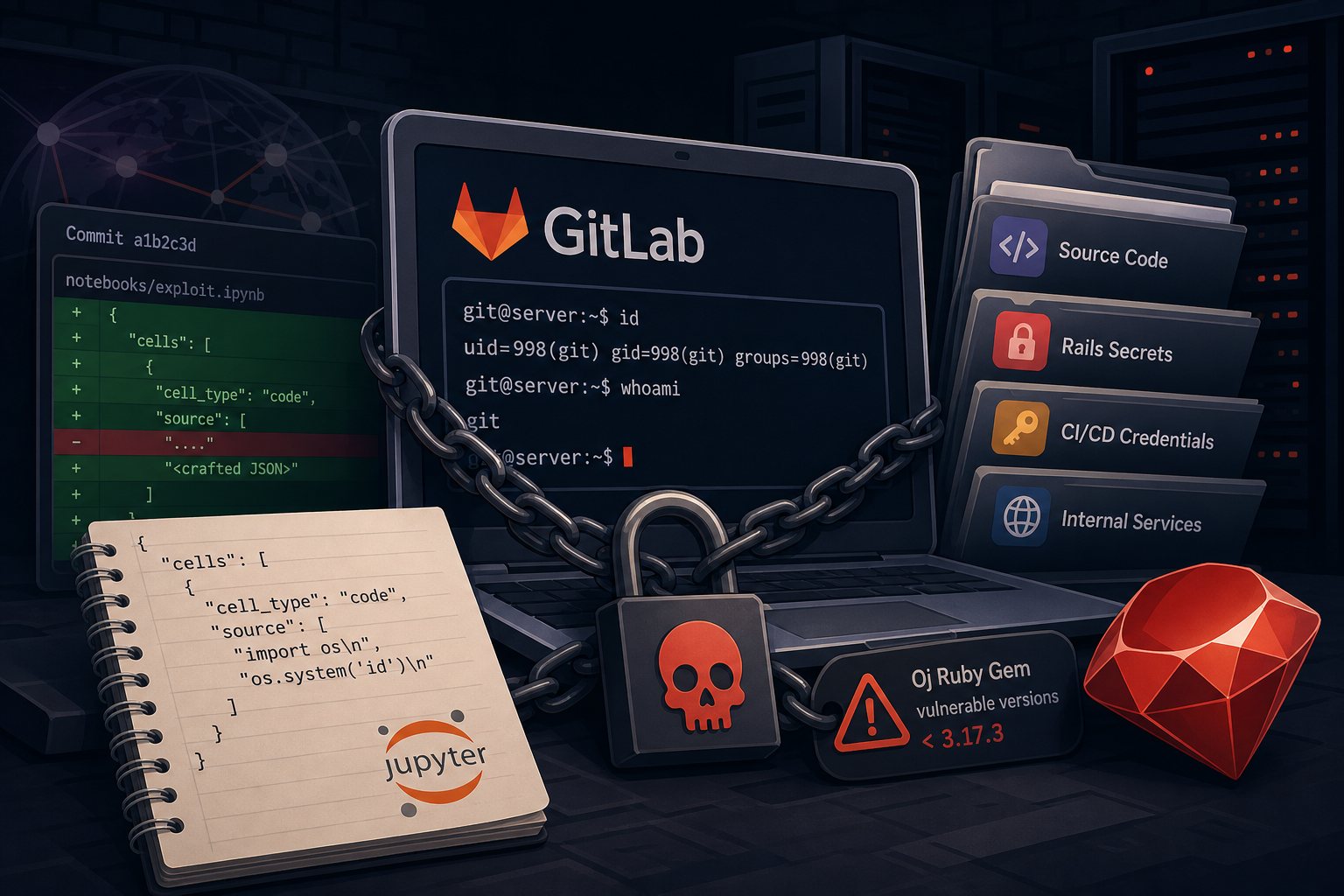
On July 24, security researchers at depthfirst published a full working exploit for a remote code execution flaw in self-managed GitLab. The exploit lets any authenticated user with push access run arbitrary shell commands as the git system account — exposing source code, Rails secrets, CI/CD credentials, and internal services. The flaw was patched six weeks earlier, on June 10. Most administrators never noticed because GitLab never assigned it a CVE.
What the Exploit Actually Does
The vulnerability lives in the Oj Ruby gem, a C-based JSON parser used by GitLab's Jupyter notebook diff renderer. Depthfirst's research identified two distinct memory safety bugs in Oj's C implementation and chained them into a working RCE.
The first bug is a stack-based out-of-bounds write triggered by excessive JSON nesting depth. When GitLab renders a commit diff involving a crafted Jupyter notebook, deeply nested JSON blows past Oj's fixed 1,024-byte parser stack, causing a Ruby Array object to overlap a parser callback function pointer.
The second bug produces a heap pointer leak. A 65,565-byte JSON object key gets silently truncated to 29 bytes by a signed 16-bit field in Oj, and the resulting truncated value gets rendered into the diff view — handing the attacker a live heap address and defeating ASLR.
Chaining both, the attacker commits three crafted Jupyter notebooks and opens their diffs in sequence. The first leaks the heap layout; the second and third corrupt the callback pointer and redirect execution to system(). The entire chain executes server-side with no administrator involvement, no victim clicks, and no CI/CD configuration required. The published PoC targets x86-64 GitLab 18.11.3 specifically; retargeting other x86-64 releases requires adjusting offsets, and ARM64 porting demands substantially more work — but neither is a meaningful barrier for motivated attackers.
Why Your Security Scanning Missed It
This one stings. GitLab's June 10 patch release listed the Oj version bump — from vulnerable releases to 3.17.3 — under ordinary bug fixes, not the security-fix table. No CVE identifier was assigned. No CVSS score was published. The underlying Oj flaws had gone undetected for approximately 1,753 days before depthfirst disclosed them.
That means patch management tools that prioritize security advisories, vulnerability scanners waiting on CVE feeds, and administrators who skim release notes for the word "security" all likely walked past this. The gap between patched (June 10) and public exploit (July 24) was six weeks — not much runway.
What's Actually at Risk
Compromise of the git user account means access to everything that account touches — and on a typical self-managed GitLab instance, that is considerable:
- Repository contents: every branch, tag, and commit on the server
- Rails application secrets (config/secrets.yml or equivalent environment variables), which can enable session forgery and further privilege escalation
- CI/CD variable stores, which routinely hold cloud provider credentials, API keys, deploy tokens, and database passwords
- Internal network access through the GitLab server itself as a pivot point
For small and mid-size businesses where the GitLab instance shares a network segment with production infrastructure, that foothold can reach a long way.
Who Needs to Act Right Now
This affects self-managed GitLab Community Edition and Enterprise Edition installations on versions 15.2.0 through 19.0.1. GitLab.com (the hosted SaaS service) was patched on the vendor's schedule and is not at risk. Instances running versions older than 15.2 — before the ipynbdiff Jupyter notebook integration was introduced — are also not vulnerable.
The patched releases are: 18.10.8, 18.11.5, and 19.0.2. Versions between 15.2 and 18.9 received no backport and require migration to a supported release branch before patching applies.
How to Check and Patch
Confirm your installed version via the Admin Area menu, or from the command line:
gitlab-rake gitlab:env:info | grep -i version
Then upgrade to the appropriate fixed release. For package-based installs on Debian/Ubuntu:
apt-get update && apt-get install --only-upgrade gitlab-ce
(Replace gitlab-ce with gitlab-ee for Enterprise Edition.) For Docker-based deployments, pull the latest tagged image for your track: gitlab/gitlab-ce:18.11.5-ce.0 or equivalent. If an immediate upgrade is not possible, audit which users hold push access across your projects and consider temporarily suspending external or less-trusted accounts — reducing the attacker pool is the only practical interim mitigation, since no toggle disables the vulnerable rendering path.
The Bigger Picture
This situation exposes a real gap in how security patch pipelines handle fixes that originate in third-party dependencies. The actually vulnerable code was Oj — a C extension gem, not GitLab's own Ruby. The Oj maintainer fixed it; GitLab bumped the gem version; the release notes called it a bug fix. From a formal disclosure standpoint, nothing was technically wrong. From a practical risk-management standpoint, a critical RCE shipped as a routine update with no advisory and no CVE to trigger your scanners.
Relying solely on CVE feeds to prioritize patching has always had blind spots, but this is a blind spot with teeth. The lesson is to treat dependency version bumps in C extensions — or any native code component — with the same seriousness as explicitly security-flagged releases. A changelog entry that says "updated Oj to 3.17.3" is worth a second look when the upstream diff touches memory safety.
At Falcon Internet, dependency audits run alongside CVE scanning for exactly this reason — a patch labeled "bug fix" does not mean "low priority" when the upstream diff touches memory management.