LiteSpeed Enterprise's Root Access Flaw: One Tenant Can Own the Whole Server
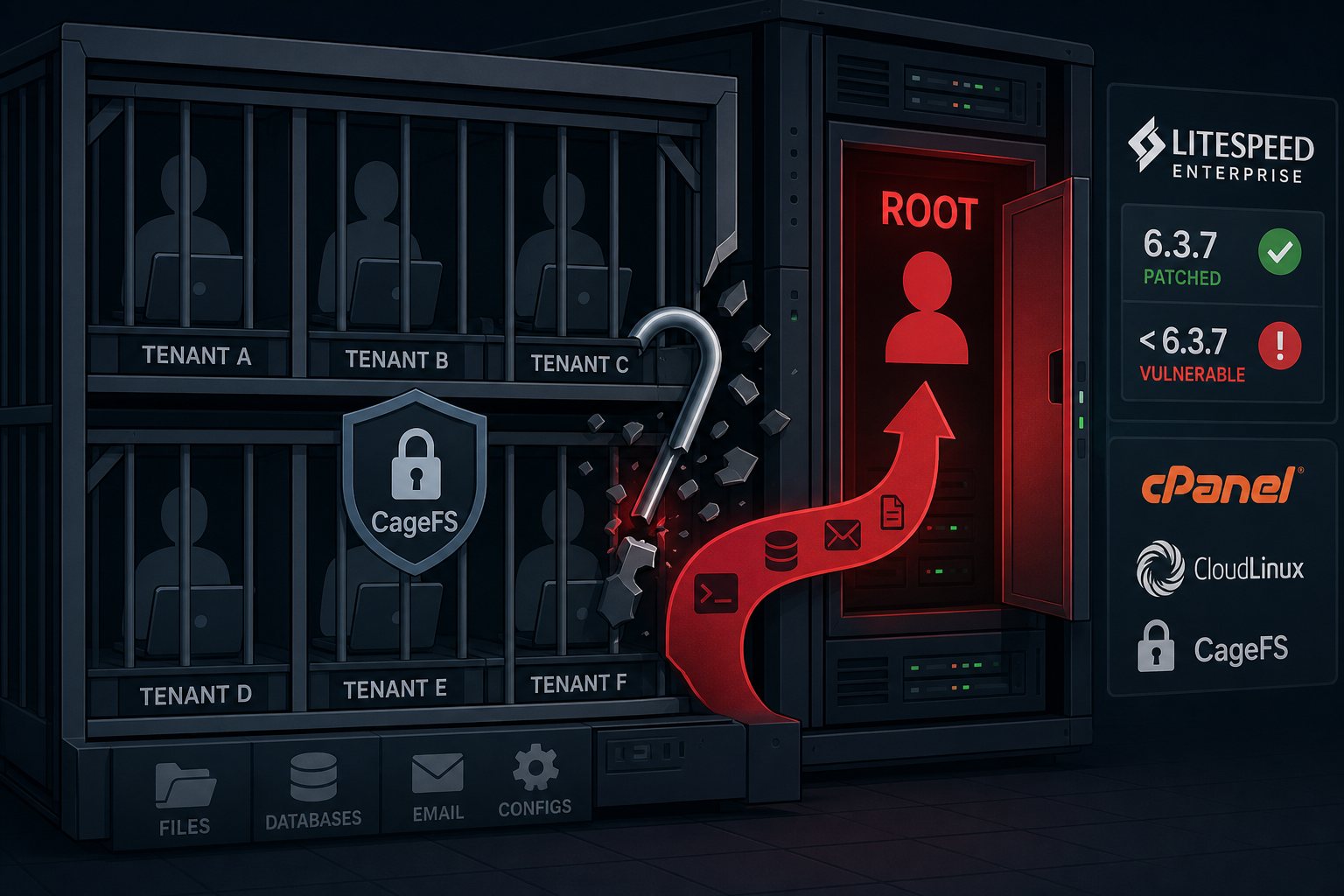
On September 14, cPanel quietly published a security advisory with an unusually blunt warning: a critical privilege-escalation vulnerability in LiteSpeed Web Server Enterprise allows a low-privilege website user to gain root-level access on a shared-hosting server. The fix — LiteSpeed Enterprise 6.3.7 — had been available since September 11, three days earlier. If your hosting provider runs LiteSpeed and hasn't updated, every tenant on that machine is a potential attack origin for every other tenant.
Why Shared Hosting Makes This Worse
On a typical shared-hosting server, dozens or hundreds of businesses share a single machine. To prevent one customer's account from reading another's files or accessing server configuration, CloudLinux's CageFS is supposed to give each account a private, restricted view of the filesystem — effectively a lightweight container per tenant. The September 14 flaw breaks that isolation. A malicious user with nothing more than a standard hosting account can escape that cage and reach root, which means they can read every other account's files, database credentials, email, and anything else stored on the server.
No CVE identifier has been assigned yet as of September 15, and neither LiteSpeed nor cPanel has publicly disclosed the specific exploitation mechanism. The deliberate opacity is standard practice when exploitation details could lower the barrier for attackers. What's clear from the patched release notes is the attack surface: LiteSpeed 6.3.7 introduces enhanced authentication and validation for lscgid requests, stronger validation of internal redirect URLs, and blocking of important internal-use environment variables from .htaccess files. Those three changes together suggest the flaw involved crafting privileged requests to lscgid — LiteSpeed's CGI daemon, which runs as root to handle certain PHP and CGI operations — either directly or by manipulating internal redirects or smuggling environment variables through site-level configuration.
Third in a Series of LiteSpeed Privilege Escalations
This is not LiteSpeed's first rodeo with privilege escalation in 2026. CVE-2026-48172, disclosed in May with a CVSS score of 10.0, let any cPanel user escalate to root by sending crafted requests to the LiteSpeed cPanel plugin's Redis enable/disable feature — essentially turning a caching toggle into a root-level code execution path. CISA added it to its Known Exploited Vulnerabilities catalog on May 26. A second related flaw in the cPanel plugin followed. The September 14 advisory marks the third privilege-escalation issue in the LiteSpeed/cPanel integration this year, and the first to sit in the web server itself rather than the plugin layer.
A pattern this consistent is a signal. LiteSpeed's deep integration with cPanel involves a privileged daemon (lscgid) bridging the gap between low-privilege tenant accounts and root-level operations. That bridge, by its nature, is a high-value target — and it has evidently required more hardening than anticipated.
Who Is Affected
The vulnerability affects all installations of LiteSpeed Web Server Enterprise prior to version 6.3.7 running on shared-hosting servers, particularly those using cPanel/WHM. LiteSpeed is among the most widely deployed commercial web servers in the shared-hosting market, favored by providers for its performance and drop-in Apache compatibility. If you're on managed shared hosting, or if you manage cPanel servers for clients, this is directly relevant.
The risk is slightly different depending on your position:
- Shared hosting customers: You may not control the server. Check with your provider — ask specifically whether they've updated LiteSpeed Enterprise to 6.3.7 and when. If they don't know, that's an answer.
- Hosting providers and system administrators: Update immediately. Auto-updates in some configurations can lag by hours or days; don't wait. Run the manual update:
/usr/local/lsws/admin/misc/lsup.sh -f -v 6.3.7, then verify with/usr/local/lsws/bin/lshttpd -v. - Agencies and MSPs: Audit every server you manage. The attack doesn't require any particular action from the victim tenant — just an attacker who already has any shared account on the same machine.
What to Do Beyond Patching
The patch is mandatory, but it doesn't address the underlying architecture: a shared server is a shared blast radius. A few additional layers are worth reviewing:
- Verify CageFS is active and current. CloudLinux releases CageFS updates independently of LiteSpeed; confirm you're running a current version (
cagefsctl --cagefs-version) and that it's enabled for all users. - Review
.htaccessrestrictions. The patch blocks certain environment variables from being set via.htaccess. If you're running a multi-tenant environment, audit any override permissions granted to tenant-level configuration files. - Check for CVE-2026-48172 remediation. If your server was exposed to the May flaw — especially if it was in CISA's KEV window — verify that the LiteSpeed cPanel plugin was also updated to v2.4.7 bundled with WHM plugin v5.3.1.0. Two unpatched paths in the same stack is not an unusual setup for opportunistic attackers.
- Rotate credentials on affected servers. With no evidence of active exploitation yet, this may feel premature — but given CVE-2026-48172 had a CISA-confirmed exploitation window, it's worth treating any LiteSpeed/cPanel server that ran vulnerable for weeks as potentially compromised until you can verify otherwise.
The Broader Lesson
Shared hosting is economical, and for small sites it's often entirely appropriate. But the security model has an inherent tension: by definition, you are sharing a root. All the isolation tools — CageFS, suPHP, mod_security, LiteSpeed's own hardening — are layers between your account and that root, and each layer introduces its own attack surface. Three privilege-escalation bugs in five months from the same vendor stack is a reminder that those layers are not guarantees.
For businesses where the website handles customer data, transactions, or operational traffic, it's worth asking the question the September 14 advisory quietly raises: how much do you trust the other tenants on your server? At Falcon Internet, that question is part of how we size and isolate customer environments — it's why neighbor-account risk doesn't factor into a typical conversation about a site going down.
The patch is out. Update LiteSpeed Enterprise to 6.3.7, verify CageFS, and check your plugin versions. Three vulnerabilities in one stack in one year is not a trend you want to watch passively.