CVE-2026-99288: Linux TCP race crashes servers, fixed in 6.12.117
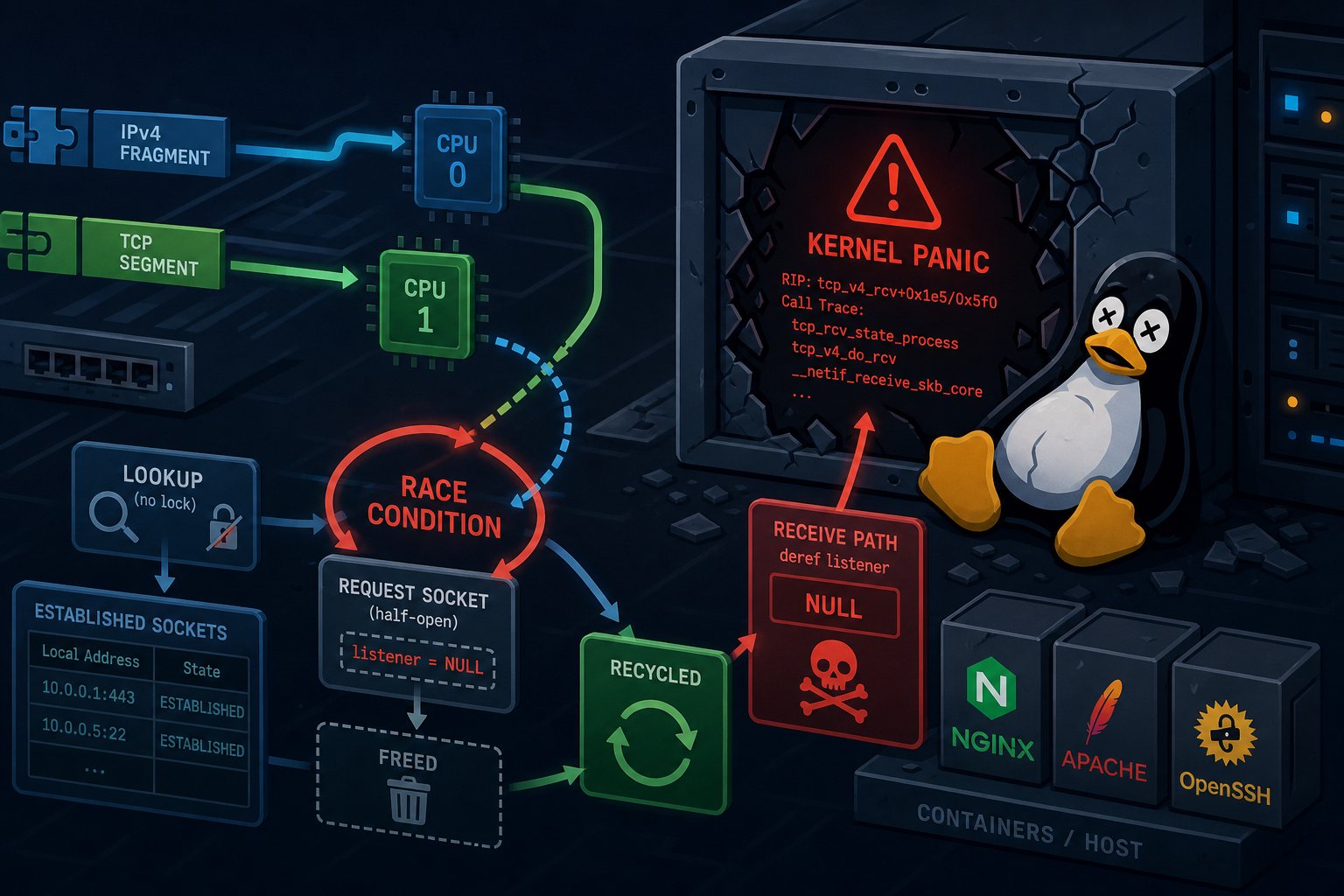
CVE-2026-99288, which researcher Hyunwoo Kim named NoisyTCP, is a race condition in the Linux kernel's TCP socket lookup that lets an unauthenticated remote attacker panic the kernel. Kim posted the details to the oss-security list at 16:00 UTC on November 15, when the linux-distros embargo ended. The bug came in with a commit dated October 3, 2015, so almost every kernel in production is in range. Default installs of Nginx, Apache and OpenSSH are exposed. No vendor or CISA has reported exploitation in the wild as of November 16.
The demonstrated impact is denial of service. Red Hat rates the flaw Important with a preliminary CVSS score of 7.5, Oracle scores it 8.1, and Ubuntu lists it as Medium priority. Asked about remote code execution, Kim wrote "Not yet." He has not released exploit code; the write-up is at github.com/V4bel/NoisyTCP.
A recycled request socket with no listener
Linux looks up established TCP sockets without taking a lock. Under load, the memory for a half-open connection's request socket can be freed and reused almost immediately. If one CPU is partway through a lookup while another CPU frees and reallocates the same memory, the lookup can return the new request socket before it has been added to the hash table. Its listener pointer is still NULL, the receive path dereferences it, and the kernel panics.
The race needs two receive contexts running at the same time: a network interface with two or more RX queues, or Receive Packet Steering (RPS) spreading packets across CPUs. Kim forces packets onto different CPUs by mixing IPv4 fragments with ordinary TCP segments, which produce different receive hashes. The SYN cookie path is part of the flow he uses. The target only has to call listen().
Virtual machines crash in seconds, bare metal in hours
Against QEMU/KVM guests running default Nginx, Apache or SSH, Kim's proof of concept crashed the kernel in 5 seconds to 2 minutes, because vCPU preemption widens the race window. Against a quiet bare-metal Nginx server with 8 RX queues, a version tuned for that machine took about 14 hours. A small business VPS on KVM with a multi-queue virtio interface falls in the fast group.
A panic triggered through a web server running in a container takes down the host kernel and every other container on it.
Kernel branches with and without the fix
The upstream fix is commit 4e2b3ef19e0e, "inet: reject unhashed sockets during established lookups," dated November 3. The stable releases of November 10 include it:
- 6.12.117
- 6.18.63
- 7.3.4
The older longterm branches do not have it yet. We checked the kernel.org changelogs for 6.6.162, 6.1.192 and 5.15.225, the newest releases on those branches as of November 16, and none contains the commit. The 7.2 branch reached end of life at 7.2.15 on November 1, two days before the fix was written, so it will not get one.
A server patched in October for CVE-2026-98432, the earlier TCP handshake bug, is still vulnerable to this one. Kernel 6.12.113 closed that bug and predates this fix.
Distribution packages as of November 16
- Debian 12 (bookworm): fixed in linux 6.1.192-2 (DLA-4906-1), a Debian backport.
- Debian 13 (trixie): fixed in 6.12.117-1 (DSA-6628-1).
- Debian testing (forky): 7.2.15-1 is listed as vulnerable.
- Ubuntu 16.04 through 26.10: the generic kernel and the AWS, Azure, GCP, Oracle and HWE kernels are all marked "Needs evaluation." No fixed package has shipped.
- Red Hat Enterprise Linux: the CVE page (Bugzilla 2570103) gives the rating and mitigations but lists no fixed kernel. We found no AlmaLinux errata for it.
- Oracle Linux: UEK kernels fixed in ELSA-2026-500630, ELSA-2026-500631 and ELSA-2026-500632, released November 12 and 13 for Oracle Linux 7 through 10.
Checking a server for the fix and the race conditions
Search the running kernel's changelog for the CVE or the commit title. A count of 1 or more means the fix is present.
# Debian
zgrep -cE 'CVE-2026-99288|reject unhashed sockets during established lookups' \
  /usr/share/doc/linux-image-$(uname -r)/changelog.Debian.gz

# Ubuntu
zgrep -cE 'CVE-2026-99288|reject unhashed sockets during established lookups' \
  /usr/share/doc/linux-modules-$(uname -r)/changelog.Debian.gz

# RHEL, AlmaLinux, Rocky Linux
rpm -q --changelog kernel-core-$(uname -r) | \
  grep -cE 'CVE-2026-99288|reject unhashed sockets during established lookups'
Then check whether the race is possible on that machine. Replace eth0 with the public interface.
ethtool -l eth0                                # Combined or RX above 1 means multiple queues
cat /sys/class/net/eth0/queues/rx-*/rps_cpus   # any non-zero value means RPS is on
sysctl net.ipv4.tcp_syncookies                 # 1 is the usual default
Take the queue count from ethtool, not from the number of rx-* directories in sysfs, which can be stale on Hyper-V guests. A new kernel package does nothing until the machine boots it, so compare uname -r with the installed version after the reboot. On the servers we manage, we are scheduling reboots onto fixed kernels as each vendor ships them.
Two stopgaps and their costs
For machines still waiting on a fixed kernel, Kim and Red Hat list two mitigations. Neither removes the bug.
The first is turning off SYN cookies:
sysctl -w net.ipv4.tcp_syncookies=0
echo 'net.ipv4.tcp_syncookies = 0' > /etc/sysctl.d/99-noisytcp.conf
The setting is per network namespace, so Docker and LXC containers with their own namespaces need it applied inside each one. With cookies off, a SYN flood can fill the listen backlog and lock out legitimate clients.
The second is serializing receive processing onto one queue with RPS and RFS off:
ethtool -L eth0 combined 1
for f in /sys/class/net/eth0/queues/rx-*/rps_cpus; do echo 0 > "$f"; done
sysctl -w net.core.rps_sock_flow_entries=0
Some drivers expect rx 1 in place of combined 1. A single queue limits how much traffic a busy multi-core server can process, and the ethtool and sysfs changes are lost at reboot unless a udev rule or systemd unit reapplies them. Keep console access available, since changing queues on the interface carrying your SSH session can drop it.